
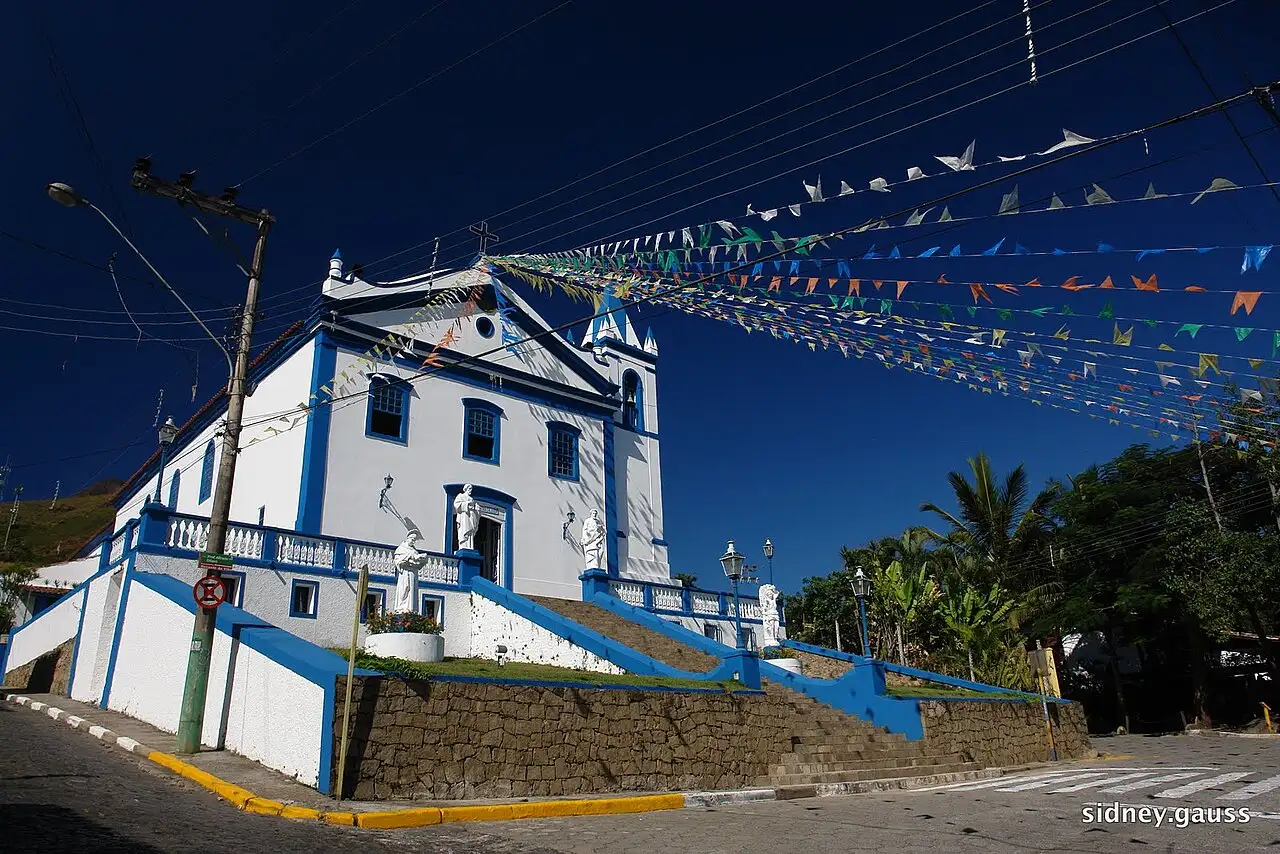

Living in Ilhabela means accepting a condition that no other city on the Litoral Norte imposes: everything goes through the ferry. In return, the island offers calm waters in the channel, a nautical lifestyle, protected nature across about 85% of its territory and a community that has grown steadily over recent decades. In this article, we bring together what weighs in the decision for those considering living on the island or keeping a second home there: the crossing, services, getting around and the property profile.
Who lives on the island
According to IBGE census data, Ilhabela had 20,836 inhabitants in 2000, 28,196 in 2010 and 34,934 in 2022. Most live in the continuous urban area on the west side, facing the channel; the Cambaquara district, in the south, had 4,500 residents in the last census. The island is about 210 km from the city of São Paulo, via the Rodovia dos Tamoios to the coast and the Rio-Santos to the ferry terminal in São Sebastião.
The pace changes greatly over the year. From December to March, high season brings more than one million visitors to the island, and in July the Semana Internacional de Vela (International Sailing Week) fills hotels, restaurants and the ferry once again. Outside these periods, residents enjoy a small town, with light traffic and almost empty beaches on weekdays.
The ferry in daily life
There is no bridge: the link to the mainland is the ferry, which crosses a channel about 2.4 km wide in 15 to 20 minutes and operates 24 hours a day. Between 5:30 a.m. and 11:30 p.m., departures run every 30 minutes; overnight, the interval increases to one hour. The fare is charged only when boarding in São Sebastião, in the mainland-to-island direction. In August 2026, a passenger car paid R$ 19.00 on weekdays and R$ 28.50 on weekends and holidays, and pedestrians and cyclists rode free, with their own line.
To avoid the lines, there is the Hora Marcada system, with reservations on the website of the responsible state department and a higher fare of about R$ 65.00 on weekdays and R$ 98.00 on weekends and holidays for cars, according to the figures published in 2026. In high season, those without a reservation may face waits of more than four hours, and cameras on the official website show the lines in real time. For those who work on the mainland or frequently receive visitors, this logistics needs to be factored in from the outset.
| Item | Amount (2026) |
|---|---|
| Crossing | 15 to 20 minutes, 24 hours |
| Daytime frequency | Every 30 minutes (5:30 a.m. to 11:30 p.m.) |
| Car, weekday | R$ 19.00 |
| Car, weekend and holiday | R$ 28.50 |
| Pedestrian and cyclist | Free |
Getting around and services
On the island, a single paved avenue runs along the west side from the far north to the far south. The municipal bus had a full fare of R$ 10.00 for visitors in 2026; there is also the Aquabus, a municipal water transport service, and a bike path on the flat stretch between the Vila and Perequê. The east side, with Castelhanos and Bonete, can only be reached by a dirt road requiring 4x4, by trail or by boat.
For healthcare, the Hospital Municipal Governador Mário Covas Júnior, in Barra Velha, near the ferry, is the only hospital in the archipelago. Managed by the Santa Casa de Misericórdia de Ilhabela, it offers an emergency room, inpatient care, a surgical center, CT scans and X-rays. For more complex care, residents turn to the mainland, starting with downtown São Sebastião, just past the crossing. The nearest airport is in São José dos Campos; Guarulhos and Congonhas handle domestic and international flights.
Shops are concentrated in the central area, from Barra Velha to Perequê and the Vila, with a supermarket, restaurants, kiosks and services. The north and south are more residential and depend on this central strip for everyday shopping.
The property profile
Ilhabela's housing stock is dominated by houses, from simple homes to high-end properties in gated communities; apartments are rare. In November 2026, a real estate portal listed 388 houses for sale on the island, with displayed listings ranging from R$ 1.8 million, for a 4-bedroom, 290 m² house in Itaquanduba, to R$ 9.5 million, for a 6-bedroom residence in Feiticeira.
In the same period, another portal showed houses at R$ 8.48 million in Curral and R$ 13 million in Bexiga, while the portal from the first search had only three apartments for sale, between R$ 650 thousand, for a 43 m² loft in Água Branca, and R$ 1.55 million, for a 2-bedroom apartment in Itaguaçu.
In the review of the São Paulo coastal market published at the end of 2025, based on DataZAP data, the average asking price per m² in Ilhabela was R$ 8,614.76 (in October 2026, the ZAP Imóveis city guide, using a different database, indicated R$ 6.3 thousand; the figures are not directly comparable), below São Sebastião's R$ 10,376.58, and rents on the island had risen 26.62% in the twelve months to November 2025.
| Indicator | Value | Reference |
|---|---|---|
| Population | 34,934 | 2022 Census |
| Houses for sale | 388 | November 2026 |
| Range of displayed listings | R$ 1.8M to R$ 9.5M | November 2026 |
| Average price per m² | R$ 8,614.76 (DataZAP) and R$ 6.3 thousand (ZAP Imóveis) | December 2025 and October 2026, different databases |
| Rent increase | 26.62% over 12 months | Through November 2025 |
What to consider before buying
- Ferry logistics: distance to the terminal matters in daily life; houses in the center and in the south near the ferry reduce commuting time.
- State Park: with about 85% of the island protected, many lots have environmental restrictions; consult City Hall before planning any expansion.
- Gated community or street: gated communities handle security and maintenance while the owner is away, which is relevant for a second home on an island.
- Services and maintenance: building materials, labor and deliveries all cross on the ferry, which can lengthen the timelines and costs of renovations.
- Size and documentation: listings mix built area and lot area; check the measurements in the property registration and the IPTU.
For an overview of the beaches and neighborhoods, see the Ilhabela guide. If the idea is to have Ilhabela nearby without depending on the ferry day to day, the mainland side also offers options, from the beaches near downtown São Sebastião to those of the Costa Sul, such as Maresias and Juquehy.
Grando Soluções Imobiliárias follows the Costa Sul of São Sebastião and Ilhabela with local partners: whether you intend to buy, sell or set up a second home in the region, we help you compare addresses, gated communities and price ranges with up-to-date data.
More in Ilhabela
Sources consulted (8)
- City Population — Ilhabela, censuses 2000, 2010 and 2022 (IBGE) (citypopulation.de)
- Real Seguro Viagem — Ilhabela: ferry, services and prices (August 2026) (seguroviagem.srv.br)
- Correio Braziliense — Ilhabela: ferry, park and 42 beaches (June 2026) (correiobraziliense.com.br)
- Jornal de Brasília — Ilhabela: access, ferry and airports (February 2025) (jornaldebrasilia.com.br)
- The Rio Times — São Paulo coast: DataZAP prices and rents (December 2025) (riotimesonline.com)
- Real estate portal — houses for sale in Ilhabela (November 2026) (chavesnamao.com.br)
- Real estate portal — apartments for sale in Ilhabela (November 2026) (chavesnamao.com.br)
- Real estate portal — houses in Ilhabela and São Sebastião (November 2026) (lopes.com.br)
Information verified on 01/11/2026. Found something outdated? Let our team know.